

Some people love habits.
They love the neatness of them. The little boxes checked. The feeling of staying on track. But if you are someone who starts feeling tired the moment something becomes a system, reading can begin to feel strangely heavy.
That is often the problem.
You do not stop wanting books. You just stop wanting the pressure around books. The reading tracker. The daily goal. The promise to read twenty pages no matter what. The quiet feeling that if you miss a day, you are slipping again.
For something as personal as reading, that can feel like too much.
Reading usually begins in a softer place than that. It begins with curiosity, comfort, escape, company, or the small relief of entering another voice for a while. When it starts to feel managed, measured, or slightly forced, some of that warmth can disappear.
That is why a reading routine does not always need to look like a habit.
Sometimes it works better when it feels like a small part of your life instead of a rule inside it.
Why habits can feel forced so quickly
There is nothing wrong with habits. For some people, they are helpful. They remove friction. They create rhythm. But for other people, habits can become a kind of pressure the moment they are named.
Reading is especially vulnerable to that.
The second you tell yourself, “I need to build a reading habit,” the mood changes. What was once something quiet and personal starts sounding like a project. Something to maintain. Something to succeed at. Something that can be done badly.
And once that happens, it gets easier to avoid.
You may still want to read, but now reading has picked up extra weight. You are no longer just opening a book. You are trying to become a person who sticks to a plan. That can make even a lovely book feel like one more thing asking for effort.
This is part of why so many people say they miss reading while still not doing it. The desire is there. The shape of the effort just feels wrong.
Reading often works better when it feels natural
A natural reading life is usually less impressive from the outside.
It may not involve a streak. It may not look consistent every day. It may not fit into a clean routine you could explain to someone else. But it often feels better from the inside.
Natural reading tends to happen in the spaces that are already yours.
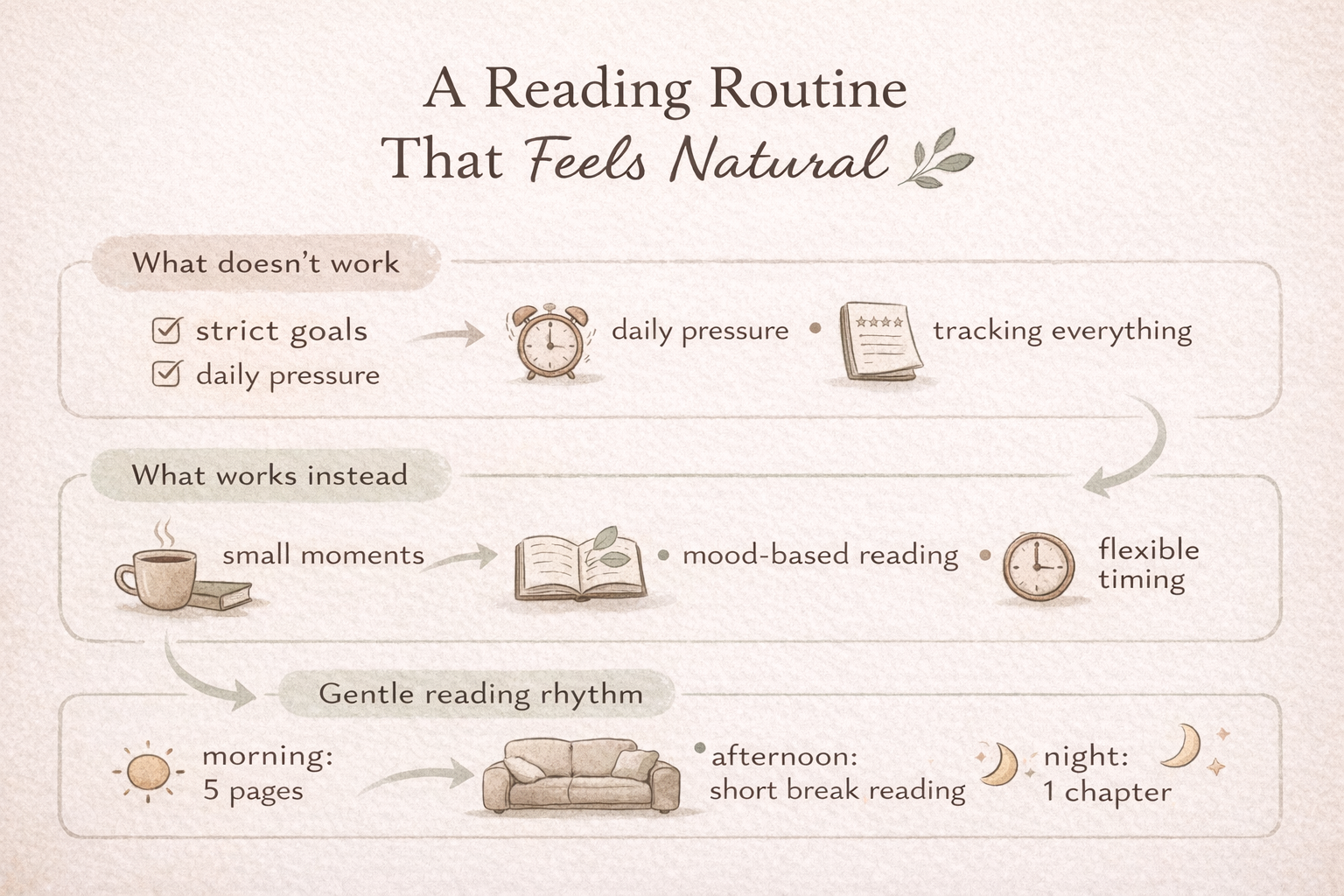
A few pages while waiting for tea to steep. Ten minutes before sleep. A chapter on a slow afternoon. A book left open by the couch and picked up when your phone suddenly feels tiring. These moments do not always look serious, but they add up to something real.
More importantly, they keep reading connected to comfort instead of pressure.
That matters because reading is not really a productivity tool, even when it helps you feel better. It is a relationship. And relationships usually grow better through ease than control.
Small moments count more than people think
One reason reading routines fall apart is that people imagine them too large.
They think reading only counts when it happens in a long, quiet stretch. An hour in bed. A whole Sunday afternoon. A beautiful window seat kind of mood. When real life does not offer that, reading gets delayed.
But small moments are often where reading actually survives.
A few minutes can be enough to keep books close to your life. Not in a dramatic way. Just enough to remind you that stories and ideas are still there, still available, still part of how you move through the day.
Some gentle ways reading fits into small moments:
- A short chapter before getting up in the morning.
- A few pages while waiting in the car.
- Ten quiet minutes after lunch before switching tasks.
- Reading one essay instead of trying to start a whole novel at night.
- Keeping a book where your hand already reaches, not where you think it should live.
These moments may seem minor, but they lower the barrier to entry. They help reading stay ordinary, and ordinary is often what makes it last.
 No-pressure reading is often the kind that stays
Tracking can be useful for some people. But if you already put a lot of pressure on yourself, it can make reading feel watched.
That changes things.
You stop asking, “Do I want to read?” and start asking, “Am I keeping up?” You stop noticing whether a book feels right and start noticing whether it helps your goal. Reading begins to feel less like a refuge and more like a quiet test you keep giving yourself.
That is why a no-pressure routine can feel so different.
You do not need a chart. You do not need a monthly target. You do not need to turn every finished book into proof of something. You can let reading be a private rhythm again.
That might mean:
- Not counting pages.
- Not worrying about how many books you finish in a year.
- Not forcing yourself to complete books that are not working.
- Not comparing your reading pace to anyone else’s.
- Not turning missed days into a story about failure.
A routine like this may look loose, but that looseness is often what keeps it kind.
Mood-based reading makes it easier to begin
Sometimes people struggle with reading not because they do not want to read, but because they keep picking books for the wrong version of themselves.
They choose the book they think they should read. The book that sounds smart. The book everyone else seems to be talking about. The book that fits some ideal reading identity.
Then they sit down with it after a tiring day and wonder why it feels like work.
Mood-based reading is softer than that.
It begins with a simpler question: what kind of company do I want right now?
Maybe you want something quiet. Maybe funny. Maybe familiar. Maybe short. Maybe thoughtful. Maybe a book that asks very little from you but still gives you that reading feeling back.
This kind of choosing is less about discipline and more about honesty.
And that honesty matters. It helps reading stay close to your real life, instead of becoming another performance inside it.
If reading has been feeling a little distant lately, something like How to Stop Phone Addiction and Read More (Without Shame or Extreme Rules) can help you return to it without turning it into a task.
Some common patterns that make reading feel harder
A lot of reading frustration comes from a few familiar patterns.
Once you notice them, things often feel lighter.
- All-or-nothing thinking: If you cannot read for thirty minutes, you do not read at all.
- Over-structuring: You create a system before you know what actually feels natural.
- Choosing by pressure: You pick books based on what seems worthy instead of what feels inviting.
- Mistaking inconsistency for failure: A few missed days start to feel like you have lost the whole thing.
- Turning reading into self-improvement: Every book starts carrying the burden of making you better.
None of this means you are bad at reading. It usually just means reading has become tangled with expectation.
And expectation can make gentle things harder than they need to be.
A softer way to start
If the word “routine” already makes you tense, it may help to think less about building one and more about making reading easier to return to.
That might look like this:
- Keep one book nearby, not five.
- Let yourself read in fragments.
- Match the book to your mood, not your ambition.
- Stop when you want to, even if it is only a few pages.
- Leave room for rereading when new books feel like too much.
You can also look for outside advice that feels calm rather than strict. Writer’s Digest often shares thoughtful perspectives on reading and writing life, including pieces like why reading the books you love again can still matter. It can be helpful when you want encouragement without too much pressure.
Let reading stay close to life
There is something comforting about a reading life that stays flexible.
It bends around your day instead of asking your day to bend around it. It leaves room for tired weeks. It leaves room for moods. It leaves room for books you abandon and books you reread and books you only manage a few pages of before sleep.
That kind of reading may not look impressive, but it feels livable.
And livable matters more than perfect.
And on days when even picking up a full book feels like too much, returning to something smaller like Best Classic Literature Starter Pack can make reading feel easy again.
A reading routine does not have to feel like a habit to be real.
It does not have to be measured, optimized, or carefully maintained. It can simply be a way of keeping books near you. A few pages here. A chapter there. A book chosen by mood. A quiet return instead of a strict plan.
That still counts.
In some ways, it may count more, because it lets reading stay what it was meant to be: something you reach for, not something you report to.
If you want more gentle reading and writing support, spend some time with the Libero Reads blog. It is a good place to keep books feeling close without making them feel like work.
One note on the links: I could confirm Libero Reads uses the /post/ format from the live site, and I confirmed the exact title/slug pattern for “How to Market a Self-Published Book” from your uploaded blog files. I could not independently verify the live public slug for “How to Write Your Own Book,” so that placeholder follows the same site pattern and may need a quick check before publishing.