
Sometimes the hardest part is not reading.
It is coming back to it.
You look at the stack of books you meant to start. You think about the version of you who used to read more easily, more often, with less hesitation. And somewhere in that gap, reading begins to feel like something you should already be doing, which makes it even harder to begin.
That feeling is more common than people admit.
A lot of people drift away from books for a while. Life gets noisy. Attention gets pulled in too many directions. Even rest can start to feel crowded. So when you finally want to return to reading, it can feel oddly uncomfortable, like walking back into a room you once knew well but have not stepped inside for a long time.
You are not doing anything wrong if it feels that way.
Reading does not disappear because you failed at it. Sometimes it just goes quiet for a while.
Why coming back can feel more difficult than it should
Part of the confusion is that reading looks simple from the outside.
You just pick up a book and start. That is what people say, anyway. But if you have not read in a while, it rarely feels that easy. There is often a layer of pressure sitting on top of the whole thing.
You may think you should pick something meaningful.
You may feel like you should finish whatever you start.
You may worry that your attention is not what it used to be.
You may even feel embarrassed that something you once loved now feels hard to return to.
That pressure makes reading feel heavier than it is.
Instead of reaching for a book with curiosity, you reach for it with expectation. And expectation can make a quiet thing feel strangely loud.
Sometimes the problem is not that you do not want to read. It is that you want the return to feel smooth, immediate, and reassuring. When it does not, you assume something is off.
Usually, nothing is off.
You are just trying to come back to something gently, and gentle things do not always happen quickly.
Losing your reading habit does not mean you lost reading
It may help to stop thinking about this as losing a habit.
That word can make everything sound sharper than it needs to be. A habit sounds like a streak, a routine, a structure you either kept or broke. Reading is often softer than that.
It is closer to a relationship.
And relationships pause sometimes. They go quiet. They change shape. They wait while life gets full. Then, one day, they begin again in a smaller, quieter way.
That is why returning to books does not need to feel dramatic.
You do not need to become a “reader” again overnight. You do not need to catch up. You do not need to prove that your attention still works or that your love for books was real all along.
You can simply start where you are.
If there is any useful way to see this season, it may be this: reading is not something you failed at. It is something you can return to.
Start smaller than you think you need to
When people try to get back into reading, they often begin with too much.
A long book. A serious book. A book everyone says is life-changing. A book they feel proud to be seen reading.
Then they open it after a tiring day and feel nothing but resistance.
There is no shame in starting smaller.
In fact, smaller is often what works.
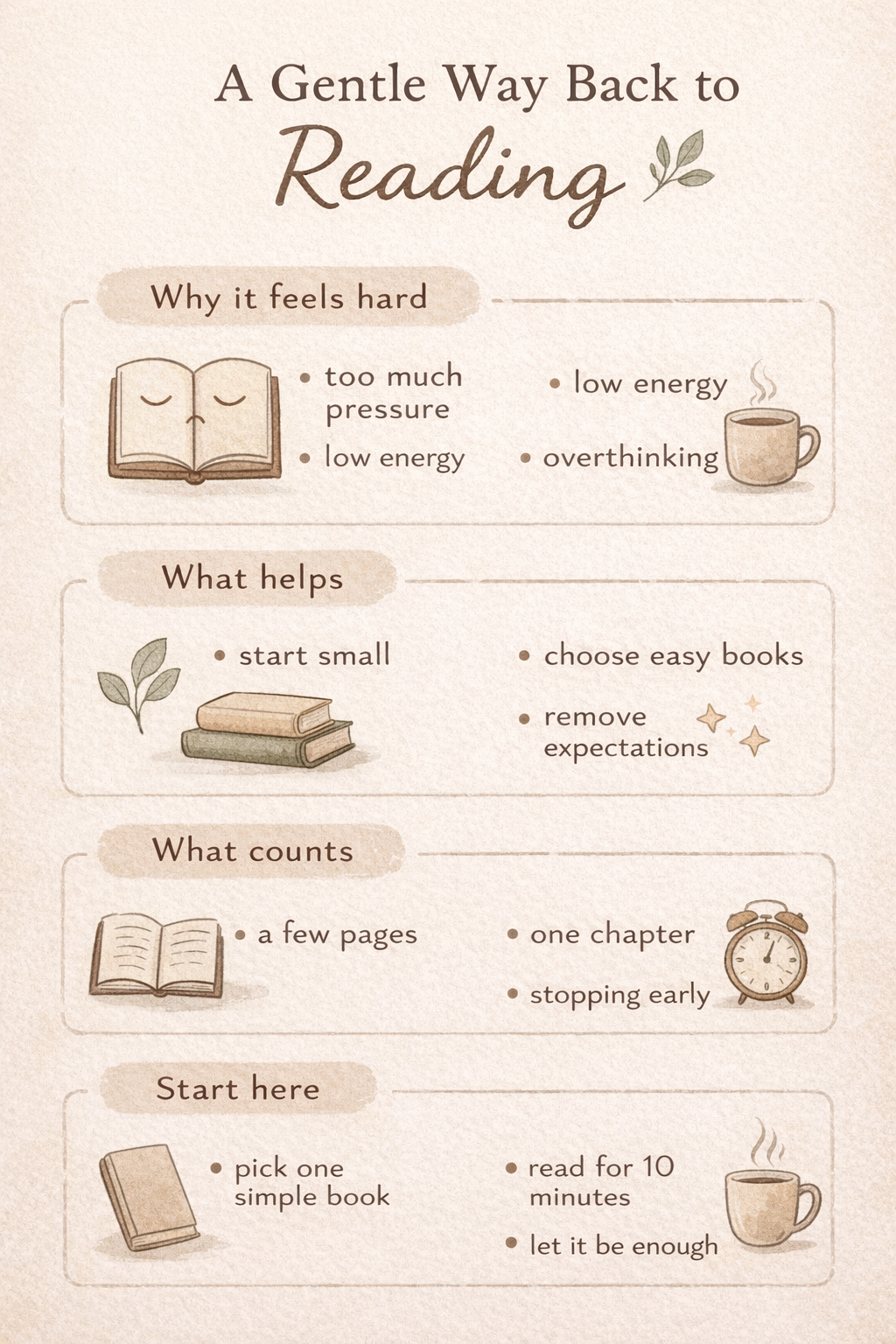
That might mean:
- A short novel instead of a long one
- A memoir with a warm voice
- Essays you can read in pieces
- A familiar book you already trust
- A story collection that does not ask for hours at a time
Small reading still counts.
A few pages still count.
Reading one chapter and stopping still counts.
Sometimes the easiest way back is not through ambition. It is through relief.
Choose easy books, not important books
This part matters more than people think.
When you are returning to reading, it helps to stop asking, “What should I read?” and start asking, “What would feel easy to enter?”
Those are not the same question.
An easy book is not a lesser book. It is just a book that meets your current energy instead of fighting it. It lets you slip in without needing to prepare. It does not ask you to admire it before you even begin.
Easy can mean different things for different people.
For you, it may be something warm and familiar. Or plot-driven. Or emotionally simple. Or quiet and absorbing. The point is not to choose the “best” book.
The point is to choose a book that does not make you tense before page ten.
That one choice can change the whole mood of returning.
Remove pressure wherever you can
A lot of reading resistance is not about books. It is about the pressure around books.
- The pressure to finish fast.
- The pressure to be consistent.
- The pressure to pick the right title.
- The pressure to read what other people are reading.
- The pressure to turn reading into proof that you are doing well again.
That is a lot to bring to something that is supposed to feel comforting.
So if you have not read in a while, it may help to remove pressure on purpose.
You do not need a reading challenge.
You do not need a tracker.
You do not need to finish every book you start.
You do not need to read every day for it to count as coming back.
A softer way to think about it might be:
- Read when it feels possible
- Stop when you want to
- Leave books unfinished if they are not helping
- Let your taste be ordinary and honest
- Trust short reading sessions
This does not mean you are taking reading less seriously. It means you are making it easier to return to.
And ease matters.
 Some common patterns that quietly get in the way
Many people who want to read again run into the same small traps.
Once you notice them, they are easier to loosen.
- Waiting for the perfect mood: You keep thinking you will start when you feel calmer, more focused, or more ready.
- Picking books for your ideal self: You choose titles that match who you think you should be instead of what feels right today.
- Turning every book into a test: If it does not hold your attention immediately, you assume the problem is you.
- Thinking reading only counts in large amounts: You dismiss ten quiet minutes because it is not an hour.
- Making the return feel symbolic: You treat one book as proof that you are back, which gives it too much weight.
None of this means you are bad at reading.
It usually just means you are asking the beginning to carry too much meaning.
Beginnings go better when they stay small.
A gentle way to begin again
If you are not sure what “starting here” actually looks like, it can be very simple.
Try this:
- Pick one book that feels light to hold, in every sense
- Read at the easiest time of day, not the most impressive one
- Aim for a few pages, not a big session
- Let yourself stop while the experience still feels good
- Come back tomorrow if you want to, not because you must
That is enough.
And if choosing a book feels harder than reading one, sometimes it helps to browse lists without treating them like assignments. Goodreads has reader-made shelves and roundups such as beginner-friendly book lists you can browse slowly, which can be useful when you want possibilities without too much pressure.
NPR also keeps a large recommendation hub through Books We Love, where you can wander through suggestions by mood and length. It includes filters like “Rather Short,” which can be especially helpful when you are easing back into reading.
Let reading feel ordinary again
Sometimes people think the return to reading should feel inspiring.
But often, it feels more ordinary than that.
You read a few pages before bed.
You notice you were a little calmer while reading.
You pick the book up again two days later.
You stop halfway through a chapter and still feel glad you started.
That quiet, ordinary return is often the real one.
Reading does not need to arrive with a perfect routine or a deep personal transformation. It can just become part of your life again in small ways. That is enough to matter.
And on days when even starting a full book feels like too much, turning to something smaller like Best Books to Start a Reading Habit can make the return feel much easier.
If you have not read in a while, there is nothing embarrassing about starting small.
There is nothing weak about choosing easy books.
There is nothing wrong with needing less pressure, not more.
Books are still there. They do not ask where you have been. They do not need a good explanation. They just wait until you are ready to meet them again, even if that meeting happens slowly.
So start with one book that feels kind.
Read a little.
Leave the rest alone for now.
That is enough of a beginning.
If you want more gentle reading and writing guidance, spend some time with the Libero Reads blog. It is a quiet place to begin again, especially when you want books to feel approachable instead of overwhelming.