
There is a particular kind of guilt that comes with not reading.
It shows up quietly. Maybe when you look at the book on your nightstand that has been sitting there for weeks. Maybe when you save another reading reel, another book recommendation, another promise to yourself that this weekend will be different. Maybe when you say, “I used to read all the time,” and hear something a little sad in your own voice.
A lot of people know this feeling. You still like books. You still think of yourself as someone who wants to read. But somehow, reading keeps becoming the thing you will get back to later.
And later can stretch for a long time.
That can feel confusing, especially if reading once came naturally to you. It can make you wonder whether your attention span is broken, whether you have become too distracted, or whether some important part of you has gone missing. But drifting away from books usually does not happen because you stopped caring. More often, it happens because life got louder, fuller, and more demanding than it used to be.
Reading asks for a kind of softness that daily life does not always leave room for.
Why reading fades without us meaning it to
Most people do not stop reading in one clear moment. It happens gradually.
You get tired more often. Your phone becomes the easier choice at the end of the day. Work follows you home in small invisible ways. Even rest starts to feel like something you should do efficiently. Reading, which once felt natural, starts to feel like something you have to earn.
Then there is the pressure around books themselves.
Sometimes the problem is not that you do not want to read. It is that reading starts to feel loaded. You want to choose the right book. You want it to be meaningful. You want to focus properly. You want to finish what you start. You want the experience to feel like it used to.
That is a lot to bring to one quiet page.
So instead of beginning, you wait for the perfect mood, the right energy, the ideal evening, the version of yourself who can sit still and fully disappear into a story. When that version of you does not arrive, reading gets postponed again.
This is one reason so many people say they miss reading while still not opening a book. The desire is real. The friction is real too.
The strange pressure of wanting books to “work”
Sometimes we do not just want to read. We want reading to fix something.
We want it to make us feel calmer, smarter, more like ourselves. We want it to pull us away from screens, help us think more deeply, maybe even return us to an earlier version of life when things felt slower and more open.
There is nothing wrong with wanting that. Books do help in those ways.
But when reading becomes tied to self-improvement, it can quietly stop feeling gentle. It starts to feel like one more area where you are falling behind. One more habit you are not doing well enough. One more thing that “should” be easy but somehow is not.
That pressure makes starting harder.
You may pick up a book and already feel disappointed in yourself for how long it has been. You may read two pages and notice your attention slipping, then decide you are not “in the mood.” You may abandon the book, not because it is bad, but because the whole experience suddenly feels heavier than it should.
This is where a softer way of seeing things can help.
Reading is something you return to, not something you fail at
It may help to let go of the idea that you have failed at reading.
Reading is not a streak you broke. It is not a version of discipline you could not maintain. It is not proof that you are less thoughtful or less serious than you used to be.
It is a relationship.
And relationships go quiet sometimes. They pause. They shift. They wait. Then, often without drama, they begin again.
You do not need to “become a reader” all over again. You probably already are one, just a tired one, or a distracted one, or one who has been carrying too much for too long.
That changes the feeling of the problem.
Instead of asking, “Why can’t I do this anymore?” you can ask, “What would make books feel welcoming again?”
That question is kinder. It leaves room for where you are now, instead of comparing you to who you used to be.
Sometimes the way back is smaller than you think
There is a common image people have of getting back into reading. It usually looks impressive.
A tidy room. A fresh cup of tea. A long evening. A beautiful hardcover book. Total focus. No interruptions.
Real life is usually less cinematic than that.
The way back to books is often ordinary. A few pages while dinner cooks. One short chapter before bed. A paperback in your bag that you read while waiting for something else to begin. A book that is easy, not important. A story that pulls you forward before your inner critic has time to speak.
This is where many people get stuck, because they think starting small does not count.
But small reading is still reading. In fact, it is often the kind that lasts.
If you have been away from books for a while, it can help to stop choosing books based on who you think you should be. Choose based on what feels open. What feels readable. What feels alive enough to make you turn one more page.
Common patterns that make reading feel harder
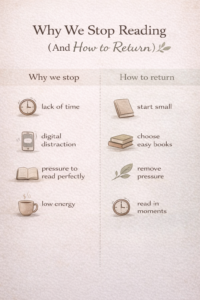
A lot of reading slumps look different on the surface, but they often come from a few familiar patterns.
One is choosing books that feel like homework. These are not always difficult books. Sometimes they are just books you think you should want.
Another is trying to read the way you used to read. Maybe you once tore through novels in a weekend. Maybe you once stayed up too late with a flashlight kind of hunger for stories. Trying to force that version of reading now can make the present feel disappointing.
Another pattern is making reading compete with things designed to win. Your phone offers endless novelty, fast reward, and no entry point. A book asks for a softer beginning. That does not mean books are weaker. It just means they ask something different from you.
And then there is all-or-nothing thinking. If you cannot read for an hour, you do not read at all. If you do not finish the book, it does not count. If your attention wanders, the session feels ruined.
Books do not need that kind of perfection from you.
Sometimes it helps to browse a list that feels low-pressure and inviting, especially when choosing your next book feels harder than actually reading it. Goodreads reading lists can be useful in that simple way. Not as homework. Just as a place to wander until something quietly sounds right.
Letting reading feel easy again
There is something almost healing about letting reading become easy.
Not shallow. Not careless. Just easy.
Easy might mean shorter books. It might mean essays, stories, memoirs, or children’s classics you still love. It might mean rereading something familiar so you are not spending energy adjusting to a new world. It might mean reading one page and stopping before the experience turns into another obligation.
This matters because reading often returns through pleasure, not pressure.
When books feel safe again, your attention starts to trust them. You stop bracing. You stop measuring. You stop wondering whether you are doing it right. You simply begin to spend time there again.
If you are curious about building a softer creative life around books, not just consuming them but responding to them, how to write your own book can sit alongside that process in a natural way.
And if you want one more gentle nudge toward a sustainable rhythm, Reedsy’s piece on building a reading habit through online book clubs can offer a simple reminder that reading does not always have to happen alone.
Start here
If reading has felt far away, start here.
Pick the easiest book to return to, not the most impressive one.
Read at the time of day when your mind is least argumentative.
Leave the book where your hand naturally reaches.
Stop before you are tired of it.
Let unfinished books remain unfinished.
Read in fragments if fragments are what your life allows.
Trust that a few pages still count.
You do not need to rebuild your entire reading identity this week. You do not need a challenge, a tracker, or a perfect routine. You just need one small moment that feels lighter than resistance.
That is often how people find their way back.
Not with a breakthrough. Not with a new personality. Just with one honest opening.
A calm way to see it
If you have stopped reading, it does not mean books are gone from your life.
It may only mean that the path to them got crowded for a while.
The wish to read is still a kind of connection. It means something in you is still listening for that quieter world. The one where a page can slow your breathing a little. The one where a sentence can stay with you all day. The one where being alone does not feel empty.
Reading is something you return to, not something you fail at.
So maybe there is no need to ask yourself to become a better reader. Maybe the gentler question is whether you can let books feel easy enough to enter again.
One page is enough to begin.